Updated May 26, 2026 02:22PM
How Katie Lamb Sent '130 BPM' (V15), One of Her Hardest Boulders Yet
To establish 130 BPM, the 28-year-old stepped away from the “over-engineered” nature of modern bouldering and listened to her gut.
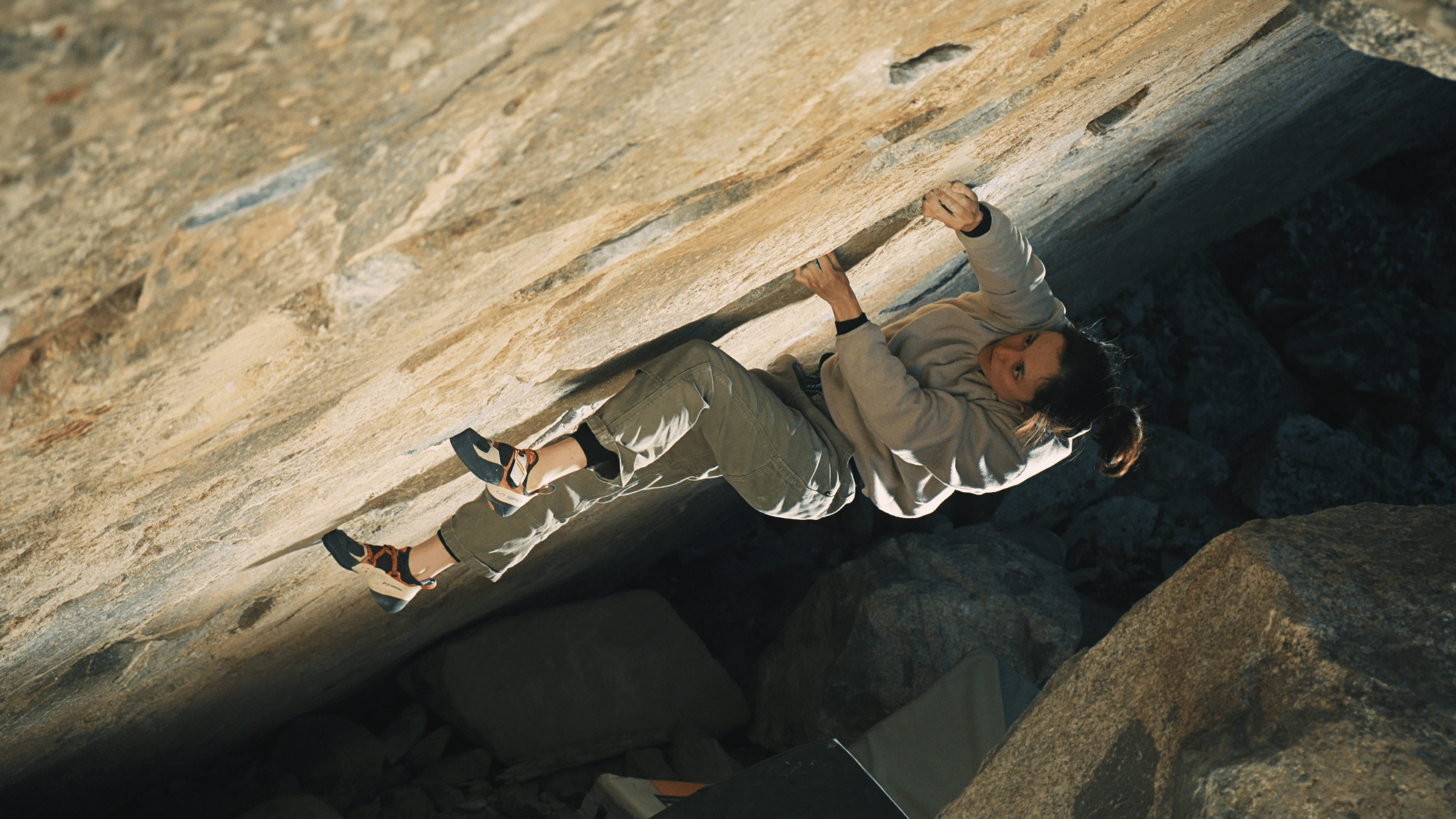
“It feels like climbing as a whole has become a lot more over-engineered," Lamb said. "There’s this mindset of, ‘There’s no excuse to not be able to do a climb, or do a move.’ You can set a replica, you can do this workout. There’s a feeling in our modern time that there’s always going to be a fix.” (Photo: Dee Limvere)
To send the crux on her new V15 in Yosemite, Katie Lamb had to revert to factory settings. “The solution was turning off the narrative that I built up in my mind about how to do the move,” she told me. “I had to go back to a beginner’s mind.”
Her new problem, 130 BPM, is Lamb’s fifth graded V15 or harder. She’s also scaled the established V15s Box Therapy, Equanimity, and Fallen Angel, and a year ago ticked V16 with another Yosemite problem, The Dark Side. Lamb has twice been the “first”—and is to-date the only—woman to climb the V16 grade: Box Therapy was considered V16 when she sent it, but was later downgraded.
Lamb’s 130 BPM is also one of the hardest boulders ever established by a woman.
In 2023, Jana Švecová proposed V14 for a variation to Terranova (V16), which she dubbed Nova, but its first repeater, Will Bosi, suggested the line was more likely V15. In March, Švecová proposed a second V15 FA, Tokyo Drift, which remains unrepeated.
The 28-year-old Lamb, who sent 130 BPM on April 22, told me it took her around 20 sessions to solve the problem, beginning in the fall of 2025.
The 15-foot-tall boulder that houses the problem sits in Yosemite Valley, near the intersection of Highway 120 and 140, which is how the problem got its name. “It’s not actually so aptly named,” Lamb joked. “It’s at the junction, but it actually sits right above Highway 120. It should have been called 110.” Lamb and Keenan Takahashi stumbled across the roadside boulder in 2024, but the first climber to try it in earnest was Aidan Roberts, who put in at least one session on it in the spring of 2025.
ADVERTISEMENT
Lamb said it wasn’t until that November, however, that she and several other strong climbers began dedicating their time to this project. “Nobody had really conceptualized the moves until then,” she explained. “Then we had a group of people trying it, but over time other people ended up in their own lanes, throwing in on their own projects, and this one suited me well, so I stuck on it.”
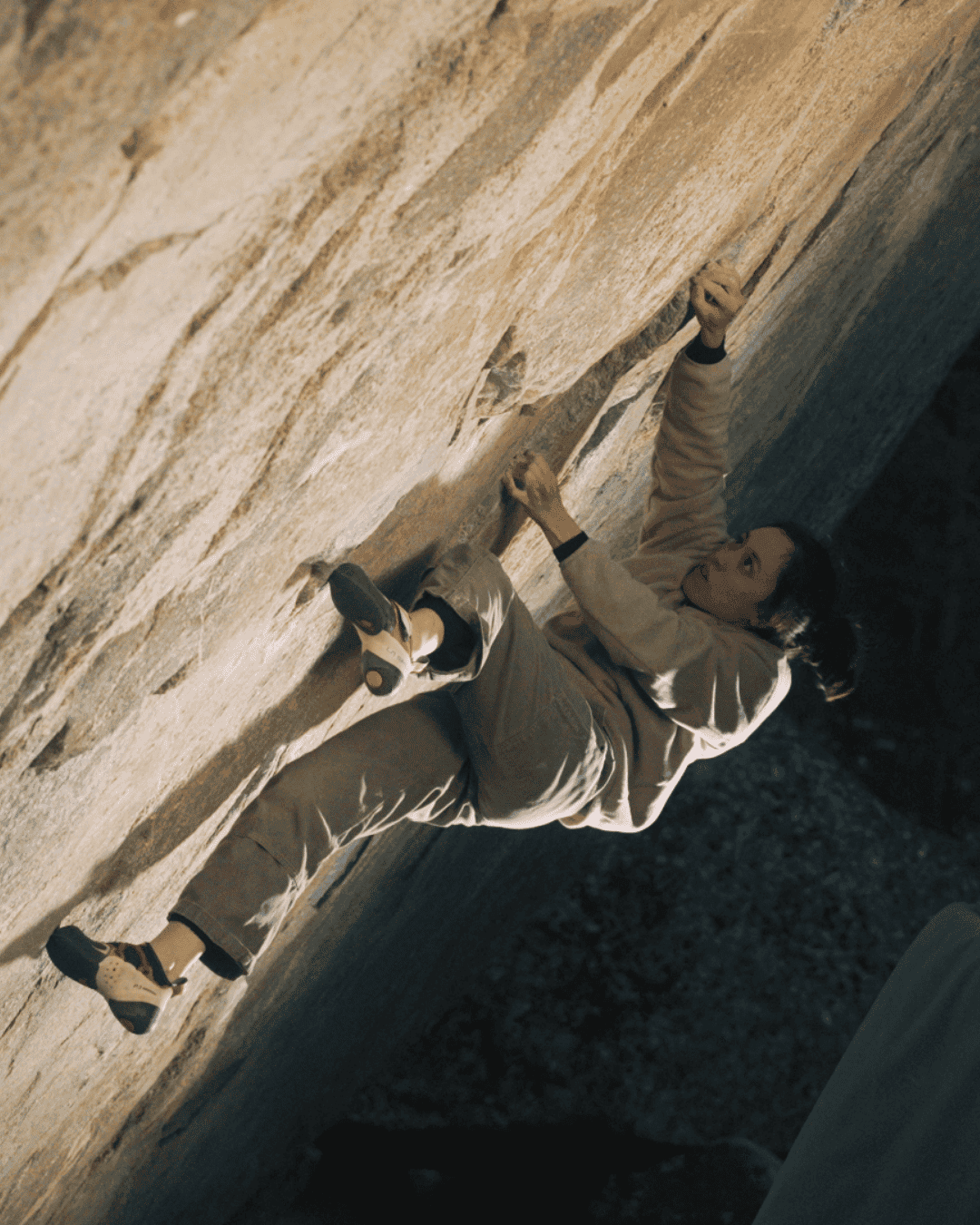
The anatomy of 130 BPM
“The problem starts on a massive jug,” Lamb said. “From there, you do three not-so-hard moves on edges, maybe V7 or V8 climbing, into two slanted edges. The holds are quite good, full-pad edges, but the feet are bad. Off of those edges you do a left foot kick that’s kind of blocked, and then a powerful cross straight into a strange left hand up.”
These edges all angle left, so the climber has to keep their weight right, and that high left foot, pressing left, is the only point of contact providing opposing force. “It’s hard, because you have to keep your weight to the right but you’re moving to the left,” Lamb said. “After that, you do a drop knee with your right leg, and then sort of a jump to a jug. From the jug, there’s probably a V8 or V9 outro sequence on crimps to the top out.” (Footage of Lamb working the crux sequence is visible on her Instagram.)
“None of the moves are really powerful,” Lamb explained. “It’s pretty technical, and most of the difficulty is because of this one bad foot that you do all of the hard moves off of. But the body positions came naturally to me.”
ADVERTISEMENT
The drop knee move at the end of the crux felt easier for her than for others who tried the rig, she said, because she has internally rotated hips, allowing her to more easily move into and out of the drop knee.
Though Lamb has sent several other V15s, this is her first time proposing a climb at the grade. She said she tries to grade problems based on geographic location, because every area has a slightly different distribution, and in Yosemite, V15 for this problem feels apt. “Basically, I thought it was probably easier than The Dark Side, and significantly harder than The Rookery, a V14 here,” she explained.
She added that with this problem in particular, body type probably plays a larger role in a climber’s experience than in many other problems. “The drop knee move that I don’t find to be hard might be the crux for most people, but maybe they wouldn’t find the lower moves as hard as I did,” she said. “It’s hard to say. The problem feels quite specific. So, as with anything, I don’t feel super confident about the grade, but it’s probably harder than V14.”
Escaping the analytical trap
When she announced her send on Instagram last week, Lamb wrote that, “I’ve spent a lot of time trying to physically emulate the best of what I see in others, maybe falling into the modern trap of believing there’s always a fix to make myself look, feel, and climb exactly how I want to.”
ADVERTISEMENT
When I spoke with her a couple of days later, she told me that while she was referencing the pressures to use a certain type of beta, or perform a certain type of way as a climber, she was also addressing a broader disposition in modern life. “I’m also speaking to a general attitude that I think we have, or that it’s easy to fall into the trap of, beyond climbing,” she said. “Peptides and Botox, and just manufacturing your way to being who you think you should be.”
Part of her experience on 130 BPM, she said, was learning to let go of that. In her post, she’d added that to solve the problem, she needed to pull back from trying so hard, at least in a technical sense. She sent all the problem’s moves in isolation within a couple of sessions, but kept fumbling once she started trying to link them. “In becoming overly analytical about how it should be done, I’d lost the instinctive feel for it,” she wrote. “I’d run up against the limits of understanding movement cerebrally at the expense of tuning into embodied intuition.”
The inclination to stuff intuition and instinct into a backseat, and oversolve, is something Lamb feels is pervasive among modern rock climbing. “There are so many training protocols, or silver bullet fixes for problems or obstacles,” she said. “It feels like climbing as a whole has become a lot more over-engineered. There’s this mindset of, ‘There’s no excuse to not be able to do a climb, or do a move.’ You can set a replica, you can do this workout. There’s a feeling in our modern time that there’s always going to be a fix.”
ADVERTISEMENT
Lamb said she often falls victim to this hyper-analytical approach. “I’ve never encountered a move that I felt like I actually couldn’t do,” she explained. “My mentality is always that I’m just doing it wrong, or inefficiently, and that there’s a way I can ‘fix it’ so that I can do it.”
That confidence is helpful, Lamb explained, but it’s also often limiting, at least to the extent that it leads her down a perpetual search for the perfect technical solution, instead of leaning into the flow. “That mentality comes at the expense of feeling it in your gut, feeling how your body naturally wants to do the move,” she said. “Being analytical about a move inherently makes one less in tune with their intuitive sense of it.”
When pioneering a new problem, as opposed to an established one with well-documented beta, hyperanalyzing a sequence is particularly confining. “With a new project, there’s no beta or roadmap, so you’re left wondering whether the way that you naturally think a move should be done is the best way,” she added, “or whether you should do the move in the way that another climber is doing it, or the way it ‘looks’ like it should be done.”
ADVERTISEMENT
On 130 BPM, for example, Lamb was able to solve the high left-handed move in the crux quickly, during her very first session on the boulder. But when she started ground-up attempts, the move rebuffed her, and eventually she seemed to forget how to do it entirely.
“In the process of trying to make that move easier and easier, I ended up completely losing the ability to do the move in isolation,” Lamb admitted. “By around session 10, I reached a point where I couldn’t do it at all.”
She hadn’t gotten physically weaker. She was just mentally overgripping. So she had to go back to the basics. “I had to think about the problem like, ‘How would I do this if I had never seen this boulder before?’” she said.
Once she tuned into that “beginner’s mind,” and “turned off all the little mental cues that I’d developed to help myself do the move,” the shift was immediate.
It still took her a while to dial and complete the rig, but the blockage was gone and progress was consistent. A few sessions later, and she was on top of a new V15.
ADVERTISEMENT
“It feels like one of my proudest sends,” Lamb said, “and it was nice to follow a slightly different process and find a new headspace. It was a good opportunity for growth.”
