Published July 20, 2026 04:29PM
100 Pounds of Gear. A Snapped Rope. One Very Lucky Catch.
Siebe Vanhee completed a first ascent two decades in the making. Now, he reveals the scariest moments and whether the 5,000-foot route was worth the risk.
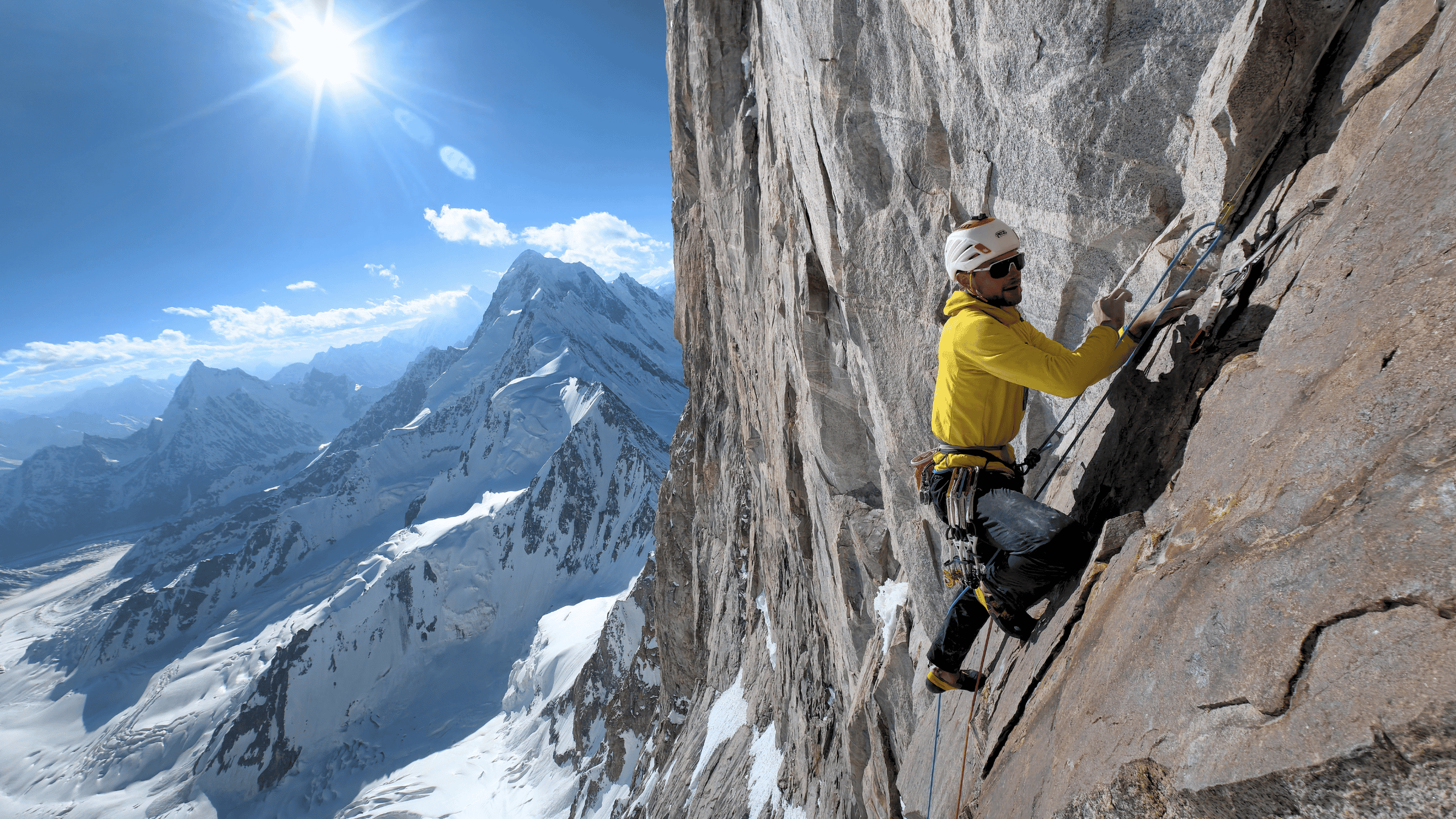
(Photo: Siebe Vanhee)
The haul bag was stuck, snared around a granite corner, and Siebe Vanhee had rappelled down to free it. Vanhee and his two climbing partners, fellow Belgian Séan Villanueva O’Driscoll and Frenchman Symon Welfringer, were more than two thousand feet up the sheer west face of Tahu Rutum (6,651m/21,820ft), a granite incisor deep in the Hispar Muztagh of the Pakistani Karakoram.
Conditions had been good, and despite loose rock on the lower wall and a tedious, slogging snow traverse, Vanhee and his friends were making steady progress, every man freeing every pitch. But if they lost their haul bag, they were hosed. The bag contained 300 meters of static line, bolts, pitons, cams and other pro, a Garmin inReach, their cell phones, down jackets, and rock shoes. To lose it would put the team in dire straits, and certainly end the expedition.
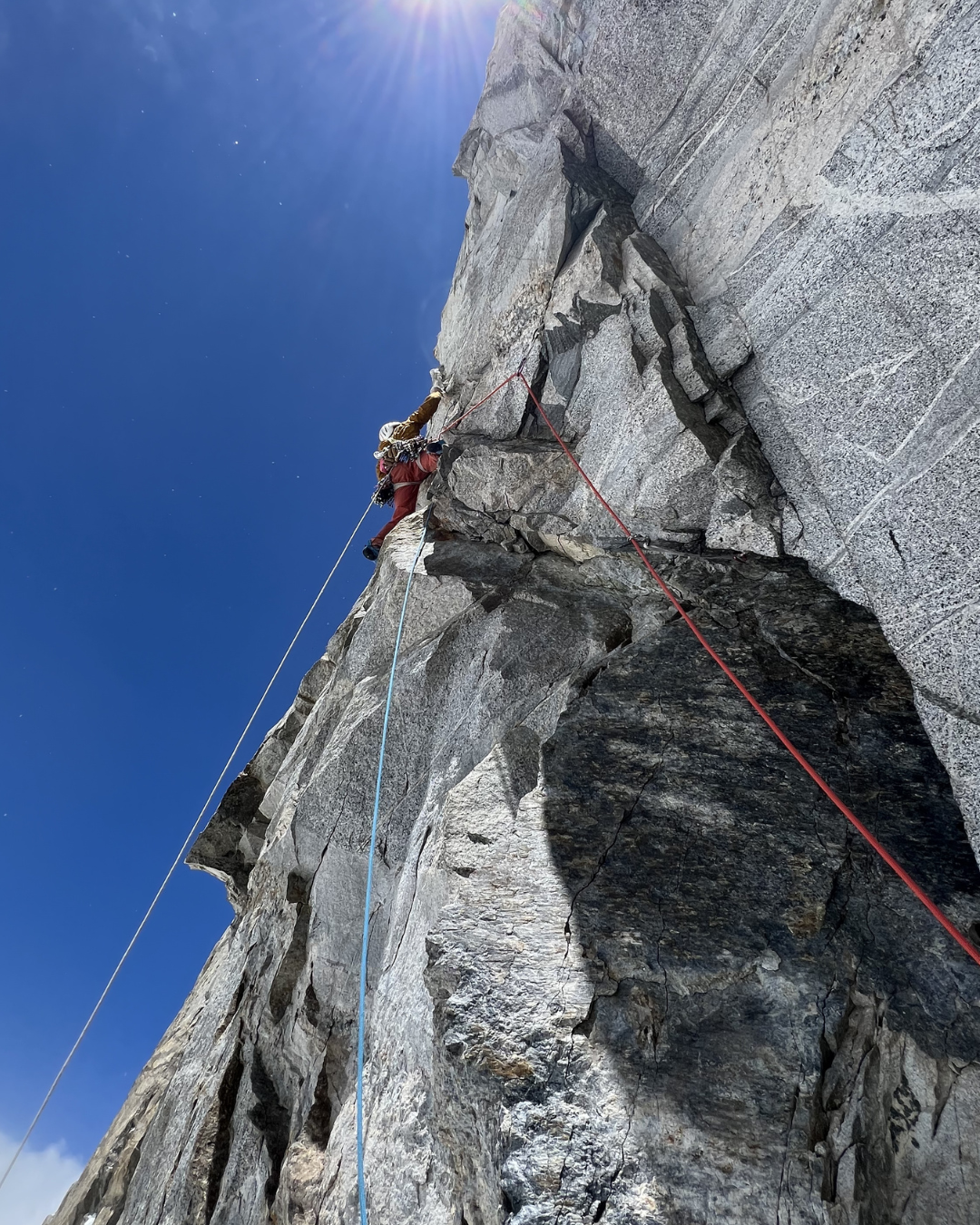
Once he reached the bag, which weighed roughly 100 pounds, Vanhee called for Welfringer to pull while he lifted. This worked at first, but when Vanhee jugged up to the bag for a second lift, he could see that the rope was running over a razor edge. With a typical thick haul line, this might have been alright, but the team was hauling using a 5mm rope.
ADVERTISEMENT
“I was like, ‘Oh man, I hope Symon is not pulling right now,’” Vanhee recalled. He reached out to grab the bag and take the rope’s weight off the edge. “Right when I grabbed it, Symon pulled really hard with his whole body weight, and it completely snapped the rope,” Vanhee said.
The 100-pound bag dropped, and Vanhee bear hugged it with all his strength.
A career of hard, long climbs—but never at high elevation
Vanhee and I sat down to talk about Tahu Rutum at The North Face’s Climb Festival, a deep water soloing competition in London, just a few days after he returned from Pakistan.
Vanhee had just given a talk about his and Tommy Caldwell’s 24-hour free ascent of the South African Route (5.12c/7b+; 1,200m) on the East Face of the Central Tower of Paine (which he wrote about for Climbing), and later that day was due to run a clinic on setting up a portaledge.
He appeared tanned and hale, but sporting the lined visage that comes from a 45-day expedition in some of the most remote, rugged mountains on Earth. “I lost a lot of muscle,” he told me, grabbing the flesh of one meaty forearm and squeezing it. (This was rather disheartening to hear, because I had just been thinking, “Damn, this guy’s ripped.”)
Vanhee told me he’d first heard of Tahu Rutum in 2014, when he met Dempster in Moab. He later read Dempster’s poignant report on the expedition for the American Alpine Journal, in which the then-25-year-old recounted 24 days aiding up the west face alone, eventually retreating just 500 feet below the summit, where the wall terminated into a lower-angle ridge.
Dempster went five days without food, battling high winds, heavy snow, and a heinous stomach illness. “Many times I collapsed, taking several minutes to stagger back to my feet,” Dempster wrote of his trek out from the peak. “Anytime I stopped, painful diarrhea would start, red blood entwined with white gooey stuff that I presumed was muscle. My body was shutting down, eating itself.”
ADVERTISEMENT
For a while, the route sat in the back of Vanhee’s mind. With a team, could he take Dempster’s line directly to the summit? But in the interceding dozen years, other projects got in the way. The first linkup of all cruxes into one mega pitch on Project Fear (5.14a/b; 1,800ft) in the Dolomites, a one-day free ascent of Orbayu (5.14b; 1,640ft) in Spain’s Picos de Europa, the first free ascent of Riders on the Storm (5.13a; 4,260ft) in Patagonia, the first rope-solo ascent of Voie Petit (5.13d; 1,500ft) in the Alps, and, earlier this year, the South African Route with Caldwell.
Vanhee knew he could take on hard free climbing, but he’d never done so at high altitude. In fact, he’d never climbed above 5,000 meters (16,400ft). “I’ve always been super curious,” he said.
In recent years, Vanhee began looking for a high-altitude objective. He first planned to attempt a new route on the west face of Latok II (7,151m/23,461ft), and gathered a team. In addition to regular partner Villanueva O’Driscoll, he enlisted French alpinist Welfringer, and British crack expert Pete Whittaker, who in 2024 climbed a remote Greenland big wall with Villanueva O’Driscoll.
For advice, Vanhee looked to Alex Huber, who had put up a new route on Latok II’s west face in 1997, with his brother Thomas, Toni Gutsch, and Conrad Anker. Vanhee and Huber had emailed about the project a few times, and the pair later ran into each other at an event last April. “From like five meters away, he saw me and recognized me,” Vanhee said. “Alex is always to the point, super funny.” Huber had a woman under each arm, Vanhee said, and he yelled over to Vanhee, pointing at him with one outstretched finger, “Very nice project, but very dangerous!”
Hearing a climber as bold as Huber tell him this sobered Vanhee’s ambitions. Whittaker, too, began expressing hesitation about Latok II, or at least about his own ability to perform at such a high elevation. “This seemed to confirm something deep inside of me that was also intimidated,” Vanhee admitted.
ADVERTISEMENT
In light of this, Vanhee recalled Dempster’s efforts on Tahu Rutum. The peak was much lower, and had only seen a single ascent, by a Japanese team who sieged its southwest ridge in 1977. The quartet switched their sights to this objective, and this year, nearly a decade after Dempster’s disappearance on Ogre II (6,960m), Vanhee, Villanueva O’Driscoll, Welfringer, and Whittaker made their way to Tahu Rutum to realize his vision.
“We chose the most ridiculous line”
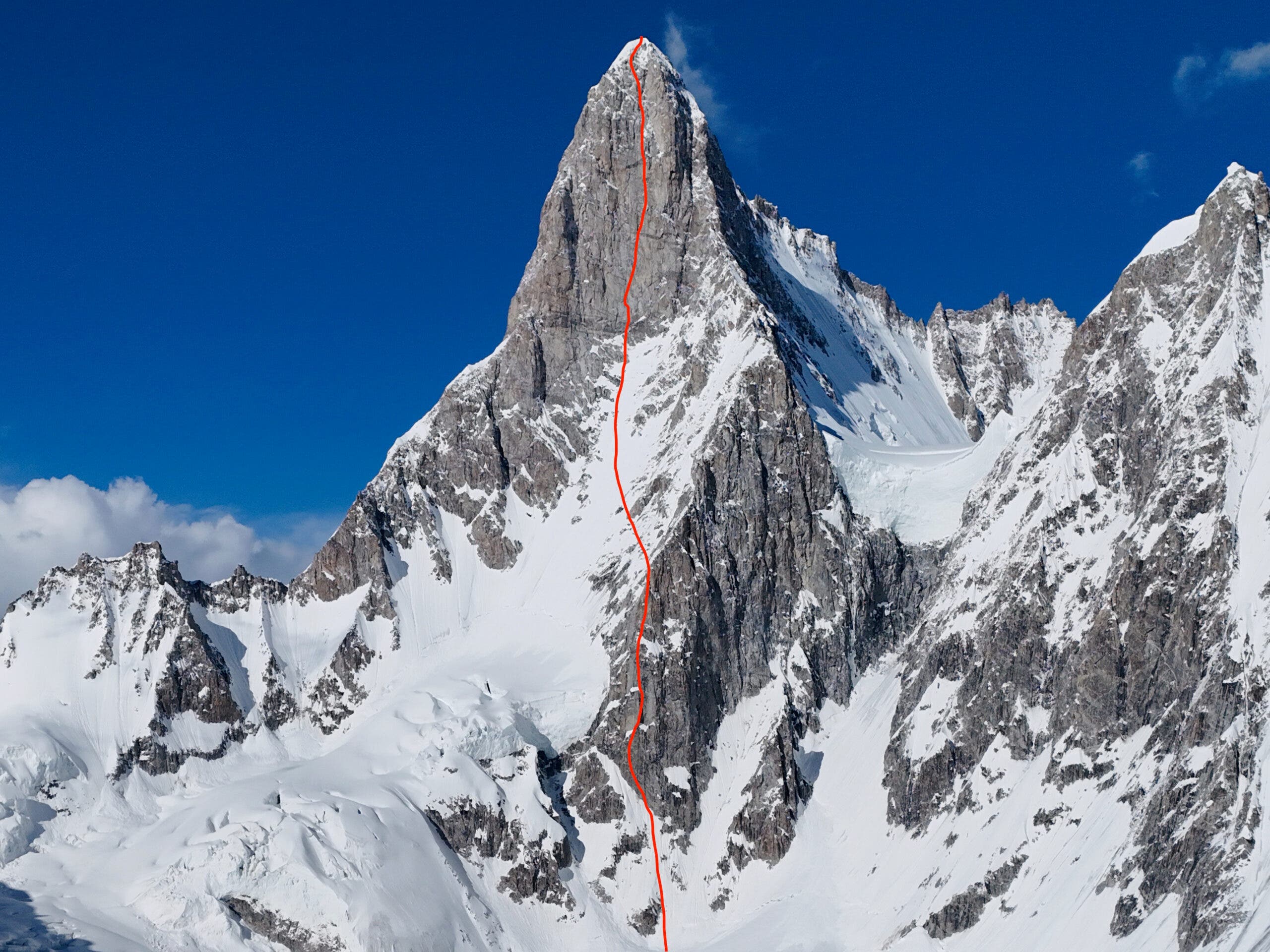
The four-person team left Europe on May 25, kitted for a 45-day mission. Once reaching base camp, however, Whittaker developed altitude sickness and returned home. The west face of Tahu Rutum is divided into three distinct sections—two rock faces rising from left to right at a 45-degree slant, with an angled glacier between them. For an alpinist looking to make an ascent of the face as quickly and safely as possible, the obvious choice would be to largely skip the lower rock face and ascend the glacier.
Instead, Vanhee and his companions decided to make their line as long and intensive as possible, avoiding the glacier and beginning at the bottom of the lowest rock face on the right. Once they’d scaled that, they would traverse across steep snow to reach the main face, hauling hundreds of pounds of big wall gear and two portaledges with them the entire time. “We chose the most ridiculous line, not a single alpinist would choose,” Vanhee noted in a press release.
ADVERTISEMENT
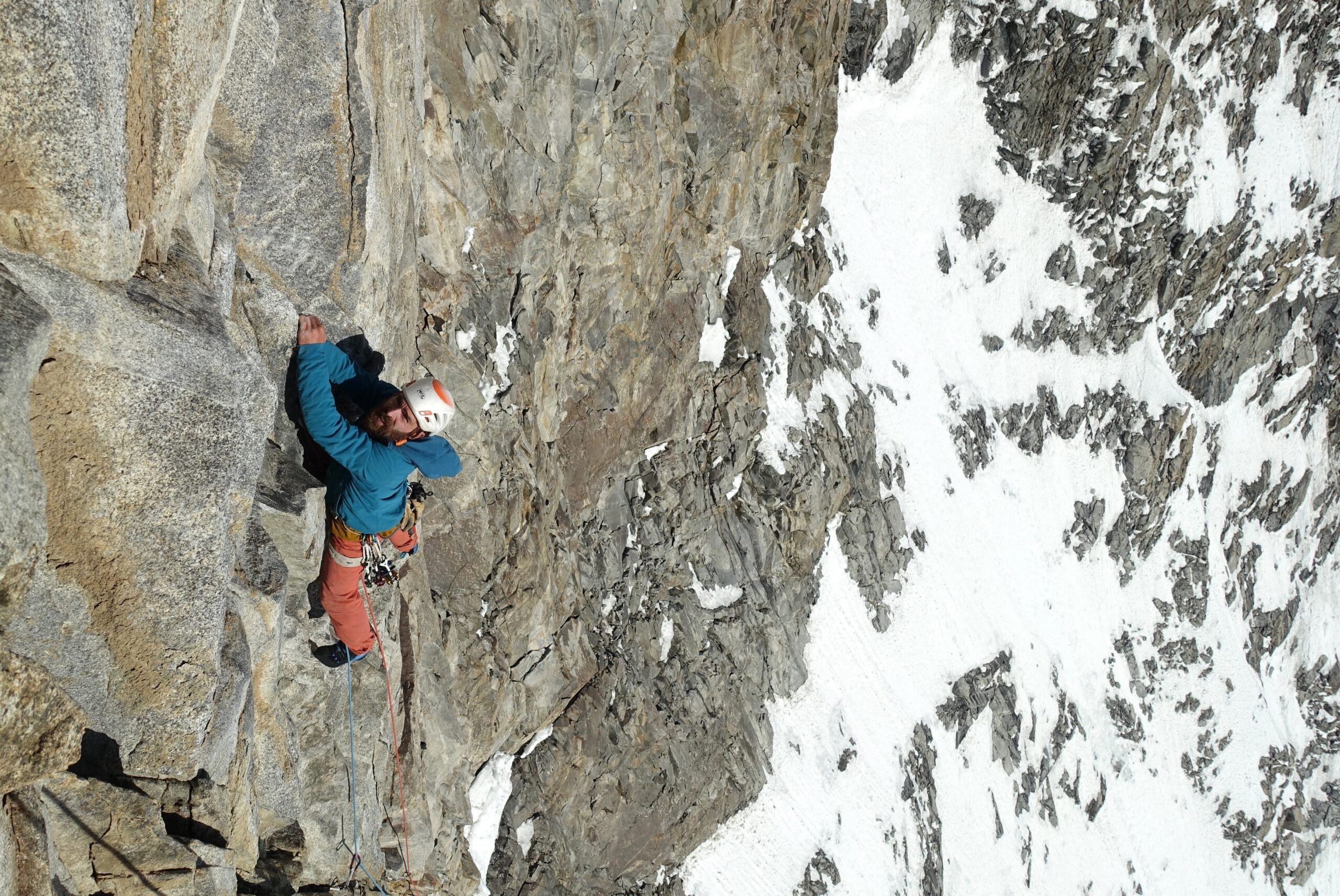
This wasn’t because the men were masochistic, Vanhee said, but because their goals were hard rock climbing, not merely summiting. “Many people give priority to reaching this summit,” he explained. “But we’re climbers, you know? We see rock, we want to climb. And if you go with a free climbing mindset, you’re mostly going to choose a line that gives you the most [technical] climbing, not the fastest way to the summit.”
The result was 1,200 feet of loose rock, leading into around 2,000 feet of steep snow, all before even reaching the main wall. This snow, in some ways, was the crux of the route, far more laborious than the technical rock above it. “It was like diagonal climbing, 70 degrees, snow and ice, sometimes a bit mixed,” Vanhee said. “It wasn’t crazy, not vertical, but the hauling on this terrain is just horrendous. It took forever.” Warm temperatures also made the going slow. “We always had to go back down by 11:00 a.m. or 12:00 p.m. because there was too much avalanche danger.”
It was during this angled traverse that they nearly lost the haulbag.
ADVERTISEMENT
Vanhee told me that when he caught it, his eyes were just high enough that he could see Welfringer and Villanueva O’Driscoll staring down at him, but they couldn’t tell what had happened. “They heard the snap, and saw the rope break, but they couldn’t see the bag in my arms,” Vanhee said. “They looked at me, and I looked at them, and it took me a few seconds to realize. He responded with a combination of adrenaline and glee. “I was screaming, ‘I got it! I got it! I got it!’” he said. He then secured the bag to the line he was jugging.
The snow traverse led into the nearly 2,000-foot main wall, the hardest, highest, steepest terrain of the route, though the difficulty capped out at two pitches of 5.12b and a couple of pitches of hard 5.11.
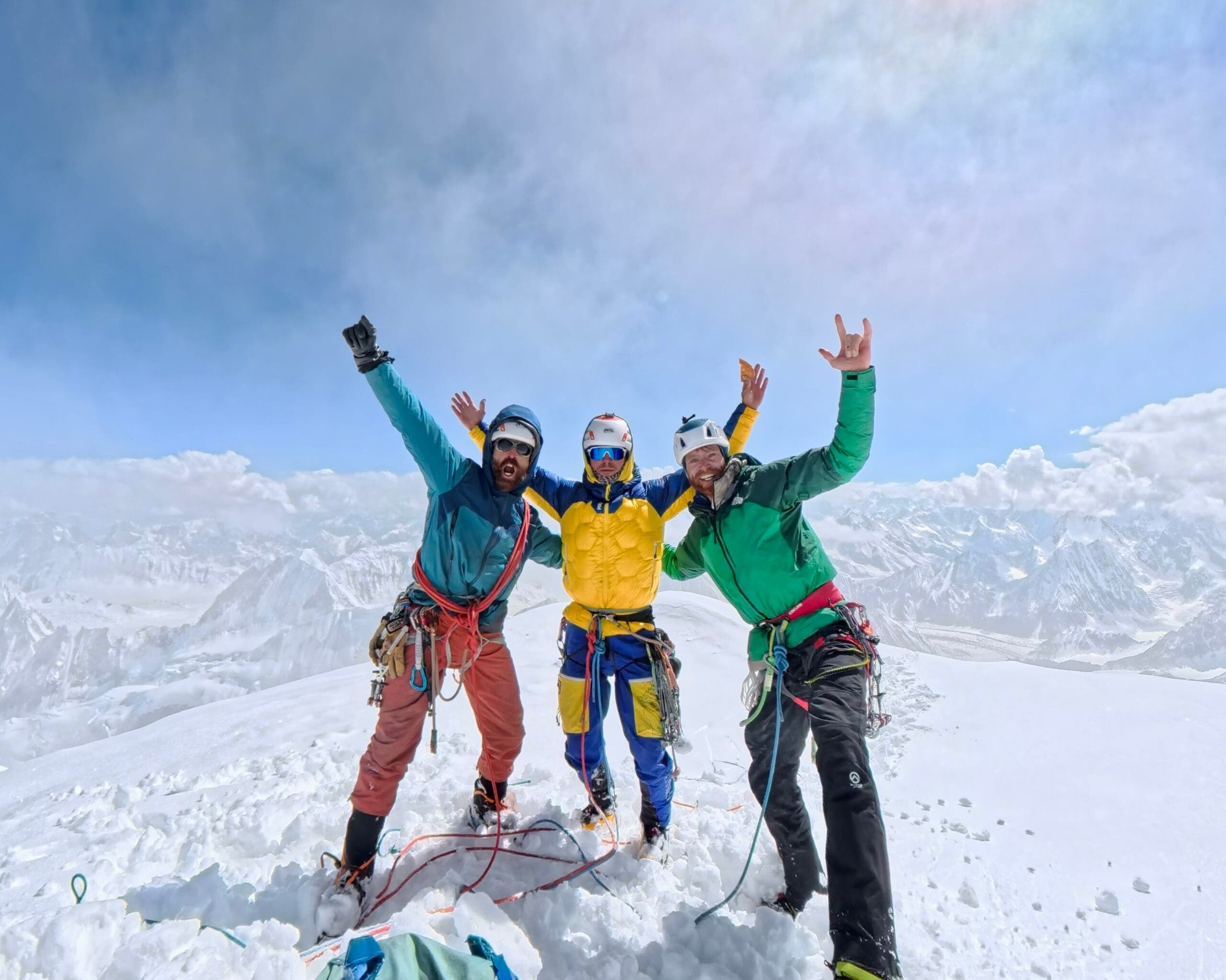
On June 27, after 13 days on the wall climbing in capsule style, they reached the summit under clear skies before descending to their high camp at 6,260m (20,538ft) for a rest day, and then taking the glacier down and out. Their route, The Leopard of Higher Ground (5.12b; 5,000ft), was named both to honor the peak—Tahu Rutum means “the home of the snow leopard” in the local Burushaski language—and Dempster, who ran a coffee shop in Salt Lake City called Higher Ground Coffee.
“For me, it was about fear”
Vanhee said that unlike most of his accomplishments, The Leopard of Higher Ground felt difficult not because of the climbing, which was quite easy compared to most of the other routes he’s established, but because of everything else that came with it: the elevation, the fatigue, the dice rolling, the fear.
“We were incredibly tired every day,” he said. “The final eight days were full on, one after the other up to the summit. If I look back, it was completely irresponsible to do the summit push on that day. We were zombies.”
ADVERTISEMENT
“I was scared quite a lot,” he added. “Loose rock, moving too quickly at the elevation. Sometimes I’d be hauling, and just have my head against the wall, focusing on my breath. It was all I could do. I’ve never experienced this much fear in so many different moments. Not on Riders in the Storm, or even the South African with Tommy.”
At one point, while hauling, the crack Vanhee was anchored to expanded. The movement blew out most of his anchor, leaving him and the haul bags hanging from a single cam. “That’s never happened to me before,” he said. The team had used the anchor extensively earlier in the day, but Vanhee said that with the warmer afternoon temperatures, the ice securing the block to the wall must have melted.
The lesson from this trip, he said, “is to keep questioning myself. What is this worth?”
When I asked Vanhee if he wanted to continue to pursue routes at high elevations, like the west face of Latok II, or go back to technical harder rock on lower walls, he appeared uncertain. “It’s a good question, because I’m really not sure,” he said. “It’s funny; I’m back, but I’m not really out of it yet.”
ADVERTISEMENT
“A couple of days after this interview, Vanhee contacted Climbing with a correction. He’d already changed his mind: “I’m pretty sure I might go back to high altitude big walls,” he said.
