Published July 20, 2026 11:10AM
Chris Sharma Reveals the Untold Story of the World’s First 5.15, 25 Years After 'Biographie'
How ego death and a month with the Dalai Lama helped Sharma on his four-year journey to crack the historic Céüse line
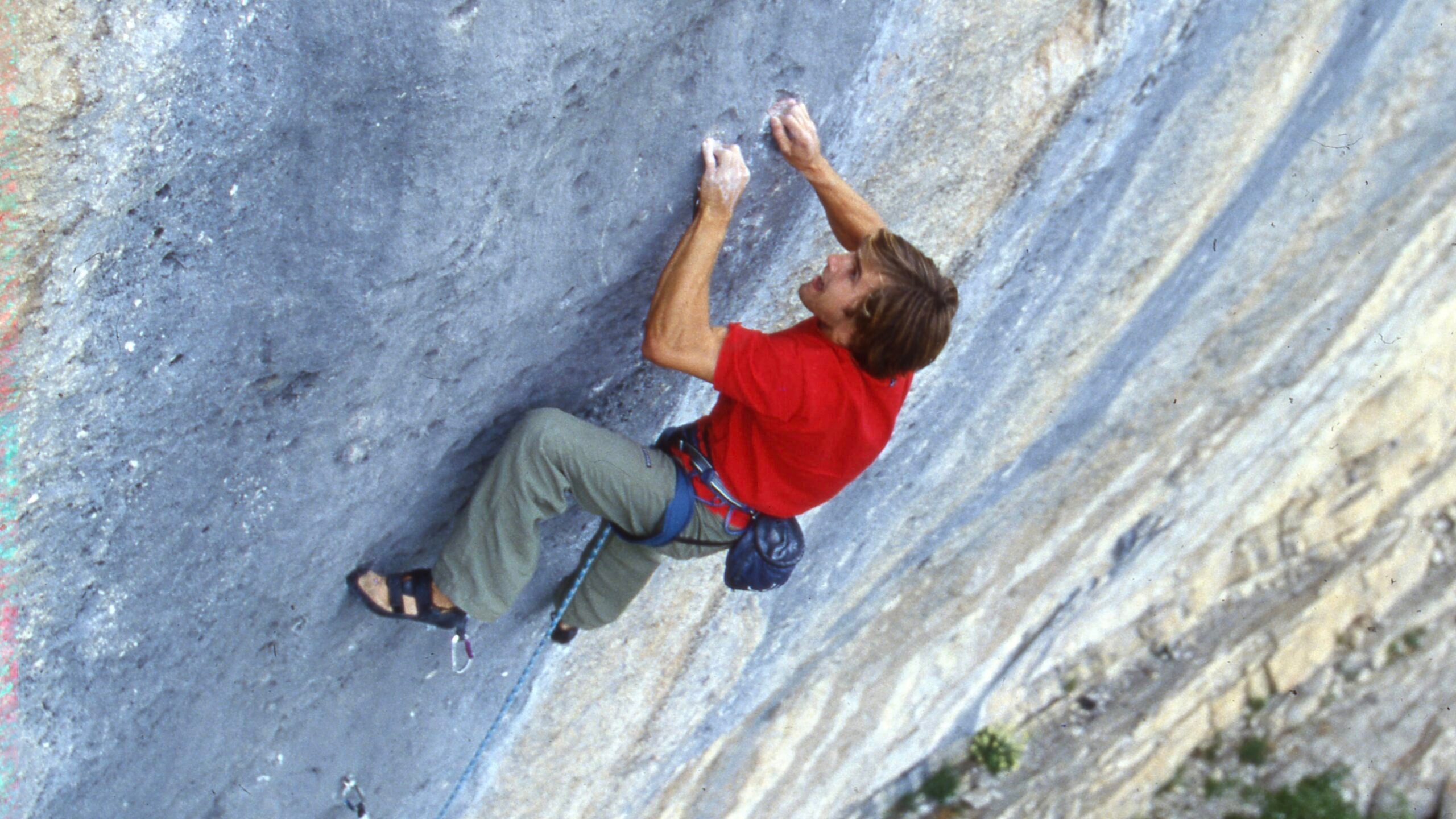
Chris Sharma on 'Biographie' (5.15a) in 2001 (Photo: Roberto Fioravanti via Chris Sharma)
Whiz kid. Unstoppable. Best in the world. Long before there was Janja Garnbret or Connor Herson, there was Chris Sharma—a tween prodigy who started climbing at age 12 and became a national champion just two years later.
“Everything in climbing had come very easily to me,” Sharma told me over a video call last week, with a subtle Spanish accent that concealed his Northern California roots. “I never had to train. I would just show up and win competitions, and I had this insane natural talent.”
When I sat down on a video call with the now-45-year-old Sharma, I found it hard to relate to the immediate success of his early years. After all, this was the kid who climbed the hardest sport climb in the world at the time. At age 15, just three years after entering the sport, he sent Necessary Evil (5.14c) in the Virgin River Gorge. To top it off, he was lucky enough to grow up before social media. To follow his passion, all he had to do was climb.
But throughout our conversation, I realized that even a prodigy’s life can include low points. At age 16, when Sharma finally found a route in Céüse, France, that he couldn’t send, failure hit him harder than most. In fact, it provoked such an intense existential crisis that he later found himself wandering around Asia for eight months to find inner peace.
ADVERTISEMENT
The journey to send the route—what we now know as Biographie (also called Realization), the world’s first 5.15—prompted an internal sea change within the climber. Sharma swore off grades entirely and struggled with the ethics of climbing on camera. He transformed from a “young punk,” as he called himself, into the preternaturally peaceful and perma-stoked climber we know today.
Whether you’re in the middle of a mega project like me, or simply trying to figure out how climbing fits into your identity, Sharma’s reflection on his own historic journey with Biographie (5.15a) offers both inspiration and wisdom for every climber who wants to push their own limits.
A conversation with Chris Sharma
The following interview has been lightly edited for clarity and length.
Sam MacIlwaine: When you sent Biographie in 2001, you called it Realization. Which name do you prefer today to refer to the route?
Chris Sharma: The route was bolted, I’m not sure what year exactly (Editor’s note: It was 1989), but Arnaud Petit climbed halfway up and put an anchor in and did the [shorter] version of the route Biographie (5.14c). So in some ways, it felt like there already was a route called Biographie. I invested a lot of time over four or five years and felt like [the extension] was so much more difficult than what was already coined Biographie that it was worthy of its own name.
[Realization] also has some cool meaning, because at that particular time in my life, I was on a spiritual journey. I started trying the route when I was 16, but I had a really debilitating knee injury when I was 17, and didn’t get back to the route until I was 19. It brought on this whole existential crisis.
MacIlwaine: Where did the word “Realization” come from?
Sharma: We were staying at Gîte in France, right at the base of Céüse. One of the women who ran the Gîte asked me one day—or maybe it was right after I did it—said the word in French for sending your project was “Did you realize your project?” (Editor’s note: The French verb ‘réaliser’ means to achieve or to fulfill.) That really hit me at that particular moment of my life. I was in this searching place, and that really resonated with me, so that’s why I proposed that new name.
MacIlwaine: You mentioned that right after your first time on Biographie, you got a debilitating knee injury. What exactly happened?
Sharma: I blew my knee out in Camp 4, bouldering in Yosemite. I already had tweaked it snowboarding a couple months prior, but then I was just messing around on a boulder in my approach shoes, and I slipped off a mantle… I remember my leg buckling and being out there just crying, ‘cause I was 17. I didn’t even know what happened, but it felt really bad. I remember my friend Dean Fidelman was there… Dean Potter was slacklining nearby.
I had this crazy future ahead of me. I had made a lot of sacrifices to follow climbing as a path; I had gotten out of high school early. I had really committed to this. And right in that moment, it all came crashing down.
ADVERTISEMENT
Also, my first girlfriend ended up breaking up with me at the same time. So it was this whole period where it felt really bleak.
MacIlwaine: How did that knee injury bring you into an existential crisis?
Sharma: [At 16] my identity was so wrapped up in who I was as a climber, and I had that kind of ripped away from me with this injury. I had this crazy trajectory where I’d only been climbing for two years and I became the national champion. It was this revolutionary moment in climbing when myself, Tommy Caldwell, Beth Rodden, and Katie Brown came onto the scene and took the U.S. climbing world by storm. I had a very quick rise to notoriety and fame and [was] climbing in the limelight, trying to make sense of that.
I was just going from one success to the next, and to be fair, I was probably a little bit cocky. I was a bit of a young punk at that point because I climbed all the hardest routes in America. I’d won all the competitions. I won my first World Cups. Losing all of that really made me question who I was and why I was doing this.
MacIlwaine: Let’s take a step back. It’s 1997, you’re 16, you’re on top of the world, and now you’re in Céüse trying the Biographie extension—what we now know as Biographie proper—for the first time. How did it go?
Sharma: It was the first time I failed on a climb. I went there and I tried it for about two months and I didn’t succeed. I fell over and over again; I think I fell about 10 times at the last move.
MacIlwaine: How did you handle that—failing for the first time in your career?
Sharma: It was very humbling for me, to be honest. So much of my climbing has always been going with what feels good. Having fun. That’s always something that’s been connected to my ethos as a climber: just finding that flow. And I think when you get to a place where things stop being fun, it forces you to question what you’re doing, why you’re doing it, but then, also, are you willing to do what it takes to become the best version of yourself? And I honestly wasn’t sure. I didn’t go back until I was 19 years old.
MacIlwaine: What did you do right after you got injured?
Sharma: That was in May, and I ended up waiting until September or something to get it operated on, to see if I was able to rehab it, but in the end, I needed to get the surgery. But yeah, I was at home in Santa Cruz.
MacIlwaine: How did the injury change the rhythm of your life?
Sharma: It was a very transformative time in my life… I was absolutely in love with [climbing], but at the same time was very caught up in the numbers, in trying to be the best or whatever. I didn’t appreciate these other aspects of it, where climbing is an art form, a way of self-realization, a life path, and [a way of] being able to appreciate nature. I was very caught up in the competitions, in performance, and everything was happening so fast. Sponsors and photographers and videos. All these things were getting thrown at me; I didn’t really have time to question any of that.
And then suddenly, I had to take a time out. I rehabbed my knee by riding my bike to this place called Panther Beach in Santa Cruz. It’s this really scrappy beach bouldering spot, but also a very serene, beautiful place. We would climb barefoot over the sand, and there’s just a wall of eliminate boulders. In that process, [I] discovered this simplicity and beauty of climbing—learning to enjoy being in nature, and climbing just for the beauty of the movement…I remember climbing at that spot literally 45 days in a row. It was my way of staying sane. This was after the surgery, and I wasn’t trying to achieve anything important in climbing.
MacIlwaine: When you eventually went back to the world of professional climbing, how did you bring those lessons with you?
Sharma: One of the first things I did was film the movie Rampage. And one of the things that was cool about that film was, we were just putting up new routes, but there were no grades at all in that movie. It was an intentional thing. I really wanted to come back into climbing in this pure way where I wasn’t doing it for the recognition or the achievement. I was trying to redefine what climbing was for myself, and it was very connected to this spiritual approach.
So yeah, going out, climbing in Bishop in the Buttermilks, putting up boulders out there, and going on this trip where we filmed Rampage were the next chapters in my climbing life. I was a different person. I was still me, but I had gone through a difficult period. Coming back to climbing, I really saw it in a different way.
MacIlwaine: So after all of this personal growth, this de-pressurizing of your climbing career, what was it like to return to Biographie for the second time, when you were 19?
Sharma: I think I tried it for a month. I was there with Josh and Brett Lowell, and I felt pressure having two cameramen with me the whole time documenting it. I would fail over and over again. It was kind of frustrating, and it made me question even more, “Is this the right approach for me to continue in this kind of mediatic way of mixing what I love with business and notoriety and fame?”
MacIlwaine: After that second month, you mentioned that you took an eight-month solo trip around Asia. What was that like, and did you climb at all while traveling?
Sharma: I climbed a little bit in Thailand; I climbed a little in India as well. But also, in between, I did periods of meditation retreats. I remember I was staying for about a month and a half in the town where the Dalai Lama lives in northern India. I ended up being there while he was giving teachings and spent a month there, attending those.
MacIlwaine: So after your Asia trip and those climbing competitions, when did you make it back to the project?
Sharma: I came back from Asia in April and went to the Phoenix Bouldering Contest. That competition is no longer around, but at the time, it was the longest-running climbing competition in the world. Then, I think in June I flew back [to Céüse] with Brett Lowell. We decided this time it was going to be more lowkey.
MacIlwaine: Tell me about that third and final season trying Biographie. You’re coming back from a lot of time off, absorbing these spiritual lessons from the Dalai Lama. But you still have this project where you’ve fallen on the last move for two seasons. How did you approach it this time?
Sharma: Interestingly enough, I really wanted to approach it—it sounds so cheesy to say it—but in this pure way. I wanted this to be an expression of this new kind of awareness that I had about myself and have this be a pure expression of who I am.
I was thinking that the best way to do that would be to just go there without anybody, without any cameras. I mentioned climbing at Panther Beach—these very special moments where you’re climbing just alone in nature, where you don’t even leave a trace and no one sees it. It’s this fleeting moment of beauty and perfection when you connect on the rock. That’s what I wanted to reproduce on this route. I didn’t want to taint it with ego and all these other layers.
ADVERTISEMENT
But I remember my dad telling me, “You should go with the film crew, and that’s the way you can actually take what you do in climbing and inspire other people with it.” That was a really interesting shift.
MacIlwaine: What exactly shifted for you?
Sharma: Up until that point, being the center of attention, being in photo shoots, winning competitions, it was all about being in the limelight. Like, it’s all about you. It becomes this ego thing. It’s unavoidable in some ways. And that was a really big shift in perspective for me because it’s not necessarily what you do, it’s how you do it. In that sense, in the same way, you don’t necessarily need to run off to a monastery in India to tap into a deeper version of yourself.
MacIlwaine: What was the key to unlocking that last move so you could finally send? Was it a beta change or just reps on reps?
Sharma: It was reps on reps, that’s for sure, but I had gotten closer. There was a period where I started breaking through the crux. As with pretty much all of the routes that I’ve climbed since, it can be extremely frustrating to fail over and over and over again. But at some point, you just kind of relinquish and let go. Whatever happens happens. I’m just going to go climb.
But it takes hitting your head against the wall over and over again because up until that point, you’re trying to capture something you can put into your back pocket to define yourself—to build up your ego. And it doesn’t work. Trying routes that are at your limit does force you to confront yourself in that way and confront failure. It forces you to strip down all of those things. It’s a small moment of enlightenment when you’re able to let go of all these trappings of who we think we are and just fully exist.
ADVERTISEMENT
In that moment, you give up, it’s like the door finally opens and you’re able to walk through. And it’s magical.
MacIlwaine: If you hadn’t sent in 2001, would you have kept trying it? Had you achieved this level of, “I just love climbing this so much that failure is not going to deter me from coming back,” or did you have a time limit for yourself?
Sharma: I think so. I can reflect on a lot of other routes I’ve done more recently. I remember on this climb Sleeping Lion that I did a few years back, I got to this point where I battled with the same things. Every project has forced me to confront these same things over again. But I get to this point where I’m so committed that I’m just going to keep trying this climb, even if it’s the only climb I try for the rest of my life. It’s that level of surrender to the climb.
MacIlwaine: Today, we know Biographie as the world’s first 5.15, but you chose not to grade it. Did you do that intentionally because you thought it would taint the route’s purity?
Sharma: Yeah. First of all, I had never climbed a 9a [5.14d] before that. I’d climbed multiple 5.14c’s or 8c pluses, but yeah, I was definitely on this trip in the same way as Rampage. We didn’t grade a single thing. I was very adamant about trying to shift the focus of climbing. I think it’s just an inherent part of being human that we want to quantify things. But climbing grades are an interesting animal, because I think people do become overly obsessed. That might actually outweigh people’s appreciation for other things that probably matter a lot more, like the beauty of the climb or the moves.
I really wanted to throw a wrench into all of that and get people thinking more about climbing in this beauty-oriented, spiritual way. I don’t mean to criticize anybody, but looking back at the ‘90s, it’s almost the nerdiest side of climbing to be hyper-obsessed over whether it’s this grade or that grade. The experience is so much bigger, but we end up getting so hung up on this one number. It’s missing the point of the beauty of what climbing is and all these amazing places we get to go.
ADVERTISEMENT
I think Biographie or Realization captures that perfectly because it is so much more than just a hard rock climb. It’s an awe-inspiring piece of rock. It’s the most beautiful piece of limestone you’ve ever seen, with this blue streak, with these yellow streaks on either side. I really wanted to re-orient things in that way.
MacIlwaine: How did it feel when subsequent ascensionists eventually graded it 5.15a?
Sharma: It was kind of awkward for me that people just gave it 5.15. I didn’t grade it, and I didn’t even want to get involved in that discussion one way or the other. For me, it was this creative, personal pursuit on the rock. This is a life-changing experience that I’ve had over five years to realize my potential in this sport of climbing, but also understand myself as a person.
MacIlwaine: What did you do when you finally sent the route?
Sharma: After that, I went straight back to Asia and I ended up doing this thousand-mile pilgrimage in Japan. I had won all the competitions, and climbed the hardest route in the world, and it was this mic-drop moment. I was like, “Oh, I think I might be done here.” Maybe this is another time to go another direction.
MacIlwaine: It’s now been 25 years after your ascent, and climbing has changed so much. One notable change is that professional athletes are expected to make social media content. What’s your advice to young climbers who want to follow in your path of climbing for the joy of it, but feel pressure to lean into self-marketing in order to build a viable career?
Sharma: It’s not easy. These days it’s a completely different landscape, and I’m conflicted about that because I don’t think it’s really conducive to world-class climbing achievements. It doesn’t really make sense for someone who’s trying to make a career out of this to dedicate five years of their life to a climb that will maybe give them a weak bump on social media. And then a week later, it’s old news. There are so many amazing climbers, but with social media, things move so fast that even the most incredible accomplishments, a month later, are long forgotten. It’s unfortunate.
On the other hand, it has the effect of preserving that experience of climbing in a pure way if you want it for the right reasons. Otherwise, you’re wasting your time. In that way, it has preserved the purity of redpoint climbing.
ADVERTISEMENT
When it comes down to brands, they want to get more eyes on their products. It’s a business, right? And it’s important to remember that. Trying to separate those two things is important, just in my own personal relationship with climbing. There’s a business side to it—working. “I’m going to do this photo shoot. I’m going to do this or that.” And then there is going climbing, which is my free time. It’s my fun time. It’s my happy place. And it’s incredibly difficult to mix those two things. It can be really toxic as well.
MacIlwaine: What do you think the future looks like for professional athletes?
Sharma: With the new generation, there are a lot of people that are a little bit more resistant to social media. I’m interested to see what the next thing is going to be after Instagram. I’ve been in that same position as a young climber, trying to make sense of it and be smart about it. I’ve been very fortunate to have been a professional climber since I was 14 years old, basically.
But I had a really interesting conversation with a friend of mine. His name is Jibé Tribout. He was the first person to climb 5.14 in America. I think he’s 64, and I remember asking him about a decade ago, “What should I do in climbing? How should I position myself?” I feel kind of bad to admit that, but it’s hard, as you want to stay relevant. I’ve only been climbing 5.15’s in Spain, one after the other, and they all start to blend together. You start to feel like it doesn’t really stand out. I was like, “What should I do?”
ADVERTISEMENT
And I’ll never forget this, but he was just like, “Chris, in 10 or 15 years, no one’s going to remember or give a fuck about anything you did, so just do what you want to do.” That was very refreshing. In the moment, things feel so important, and it’s normal to want to optimize everything that we’re doing, but there’s an incongruity with a passion for climbing and always trying to align that as a career path. It may or may not come together, and I don’t think it’s always correct to assume that they should.


